In short: for a small business or a tradesperson, handing Google Ads and Meta Ads campaigns to an agency usually costs less than hiring, and gives access to several skills at once. Bringing it in-house makes sense once the ad budget is large enough to fund a dedicated team.
It's the classic dilemma for any growing business. You've understood that to reach the next revenue milestone, word of mouth is no longer enough: you need to invest in paid acquisition (Google Ads, Meta Ads).
A strategic question then arises: should you hire someone in-house to manage this budget, or hand the keys to your growth to an expert agency?
While the idea of keeping control in-house is appealing on paper, the reality on the ground and in terms of profitability is often very different. Here's what you need to know before making your decision.
1. In-house: a false economy?
The main argument for bringing it in-house is often financial:
“Rather than paying agency fees, I'll pay a salary, and the person will handle other tasks too.”
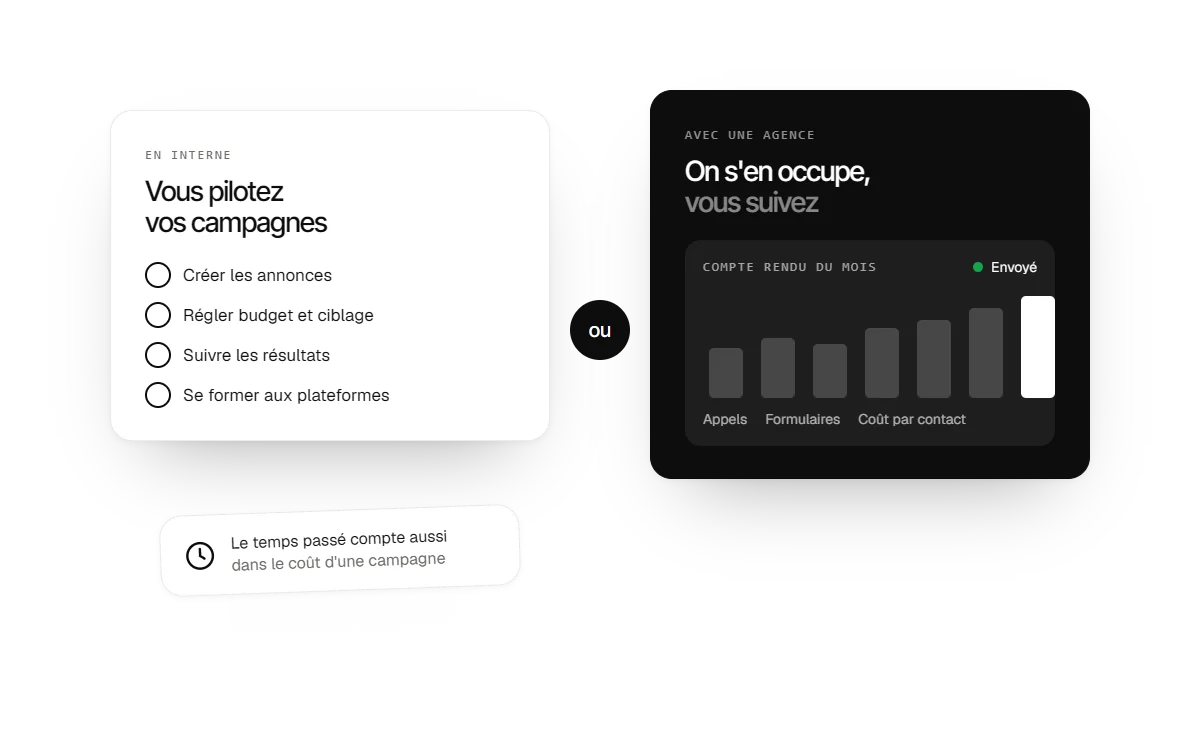
This is where the biggest trap lies. Managing advertising campaigns (media buying) is a job for hyper-specialists. Google and Facebook algorithms change every week.
- If you hire a junior (or an apprentice): They will learn their trade by spending... your budget. Set-up or targeting mistakes are extremely costly.
- If you hire an expert (senior): A true acquisition expert is very expensive (salary, employer contributions, bonuses). Are you ready to take on a senior salary, contributions included, before spending a single euro on advertising?
- The in-house advantage: A perfect and exclusive knowledge of your product, as the person is immersed in your company culture every day.
2. Delegating to an agency: the profitability accelerator
Hiring a specialist agency means buying a shortcut to performance. You're not just paying for working time, you're paying for data, experience and proven methods.
Here's why an agency is often the most profitable choice:
- The “skills cocktail” effect: An ad that converts today doesn't depend on technical settings alone. You need a Copywriter to write persuasive copy, a Designer to create a visual that stops the scroll, and a Media Buyer to optimise bids. An agency puts an entire team at your disposal for the price of a fraction of a salary.
- A market view (benchmarking): An agency manages dozens of ad accounts across various sectors. It knows exactly which strategies are working right now, which algorithm updates to take advantage of, and which ad formats are saturated. An in-house employee is often too close to the day-to-day and loses this overall view.
- Zero overheads, 100% flexibility: No paid leave, no social contributions, no training time, no risk of sick leave right at Black Friday or your busiest season. If you need to cut budgets, you have no redundancies to manage.
3. The cost of missed opportunity
What costs the most in paid acquisition is neither agency fees nor salaries. It's advertising budget spent at a loss and missed sales.
A worked example, to illustrate the reasoning: if you invest €2,000 a month in ads with an in-house person who generates a return on investment (ROI) of x2, you earn €4,000. If you give the same €2,000 to an agency (even paying €1,000 in management fees) whose expertise generates an ROI of x5, you generate €10,000.
So the question isn't “How much does the agency cost?”, but “How much does the expertise bring me?”.
The verdict: what's the right choice for you?
- Bring it in-house if: Your ad budget is large enough, and you can afford to hire a complete acquisition team (senior media buyer, creative, data analyst).
- Delegate to an agency if: You want to scale quickly, control your fixed costs, and entrust your budget to experts whose sole job this is, while you focus on running your business as a whole.
At THRPUB, we are not mere executors. We become your outsourced acquisition team, focused on a single goal: lowering your acquisition costs and increasing the number of enquiries. Managing a campaign costs €90 a month, with no commission on your ad budget (see our pricing).
Sources
- Google Ads Help — Actual cost-per-click (CPC)
- Google Ads Help — About Smart Bidding
- Meta Business Help — About ad auctions
 Written byMartin ThéryFounder of THRPUB
Describe your project: Martin will reply in writing, with tailored advice.
Ask my question