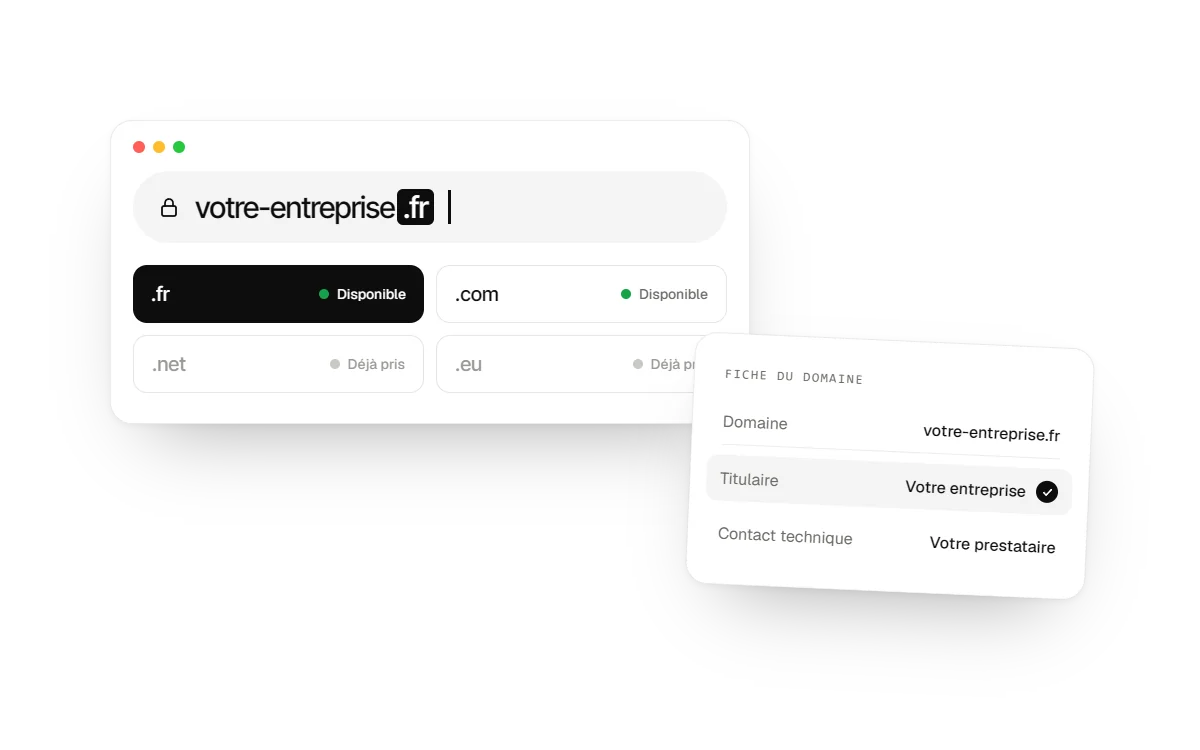
The domain name is the “your-company.com” part of your website and email addresses. It is rented by the year from a registrar, and renewed as long as you pay.
Choosing the name
- The company name first. It's the one your clients type and remember.
- Short and easy to spell out over the phone: avoid multiple hyphens, numbers and ambiguous spellings.
- No accents, to avoid typing errors.
- Check the trademark : a name already protected by another company can be claimed from you.
Adding the city or trade (“roofer-lyon.com”) brings no decisive advantage on Google: the content of your pages and your Google Business Profile matter far more.
Choosing the extension
For a business working in France, the .fr is the natural choice: it inspires trust and signals your market. The .com makes sense if you're targeting international clients. If the budget allows, reserving both prevents a third party from taking the other.
Whose name to register it in: the most important point
The domain must be registered in your company's name, as the registrant. The registrant is the owner — not the person who handled the paperwork, nor the one who pays the invoice.
The classic trap: a provider registers the domain in their own name, sometimes “free” with the website. The day you want to change provider, you discover your address doesn't belong to you. Recovering a domain in these conditions can take weeks, or fail altogether.
At THRPUB, it's a rule: the domain is always in your name, and we help you buy it.
What it costs
A standard .fr or .com costs from a few euros to around twenty euros a year depending on the registrar. Beware of very low introductory prices in the first year: look at the renewal price.
Not losing it
- Turn on automatic renewal.
- Keep an up-to-date contact email address with the registrar: that's where expiry alerts are sent.
- Store your login details somewhere safe.
An expired domain can be bought by anyone. For a business, that means a website and emails out of service overnight.
 Written byMartin ThéryFounder of THRPUB
Describe your project: Martin will reply in writing, with tailored advice.
Ask my question